Run your whole business on one system
Backbone gives you the software and the people to quote, produce, deliver, invoice and pay — from one place, built for how business runs here.
No card for 30 days · Your data stays yours · Set up in days, not quarters
Find the right fit for your business
Answer two questions and see your monthly price — the same figure your quotation will carry.
and I want to know what that costs.
fromGH₵ 1,038.01a month
up to 5 people
Included
- Sales and quotations
- Production planning
- Stores and inventory
- Shop floor
- Despatch and delivery
- Accounting
An estimate. The figure that binds is the one on the quotation we send, worked out by the same rules.
Already running on Backbone
- StarTech Multimedia and Supplies
- A training provider in the Central Region
Named with permission. An organisation that would rather not be named is not named, and is not counted here either.
Most firms here run on four systems that disagree
A quotation in a spreadsheet, stock in a book, payroll in another spreadsheet and the accounts at the accountant. Each is right on its own and no two agree at month end.
A price built from memory, with the margin found out after the job is delivered.
The rack says one thing, the book says another, and the reorder happens twice.
Numbers re-typed from one place into another, with the errors found by the accountant.
One chain, and nothing is typed twice
Every stage passes the work forward complete, so your team stops re-keying and no job moves before the one in front of it is finished.
- Quote
Built from the job, with the margin checked before it leaves.
- Plan
Material, suitability and capacity confirmed before release.
- Make
Claimed, run and reported from the floor, offline if need be.
- Deliver
Proven at the door, invoiced on what was accepted.
See the screens your team will use
Real screens from a running installation, captioned so you can follow exactly how the work moves.
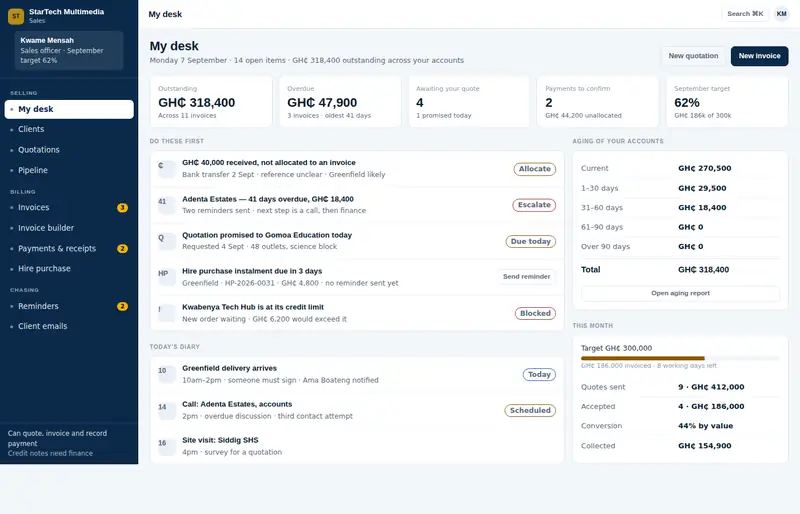
A sales officer’s desk
Five things to do first, ranked by what it costs to ignore them. The unallocated payment is above the overdue invoice because allocating it may clear the overdue.
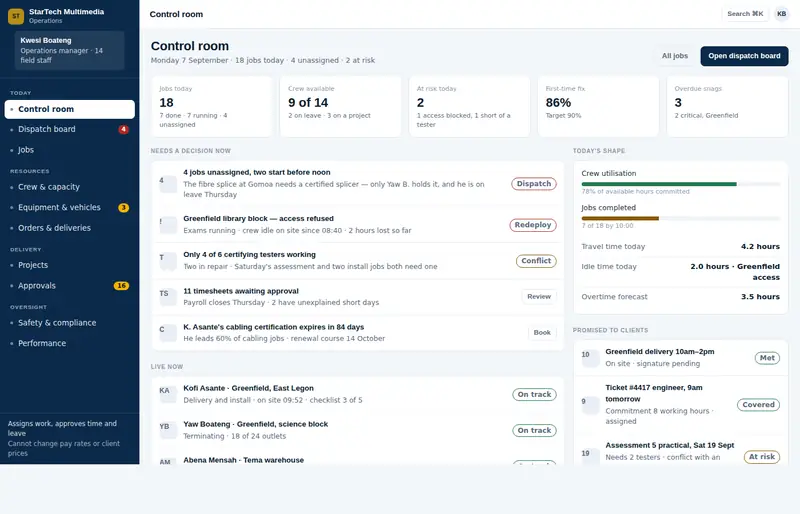
Operations manager
Capacity by day bucket, with an overload shown as three named options rather than a red cell.
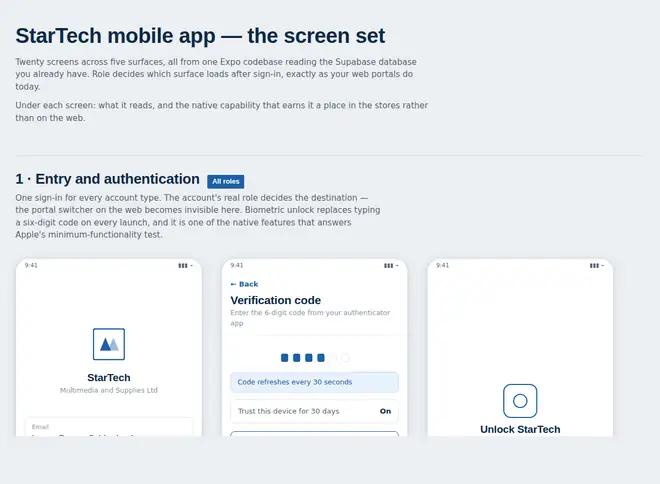
On a phone
The shop floor and the field, built for a thumb and a glove. It keeps working when the network does not.
Start where it pays off fastest
Nobody adopts everything in one quarter. Each of these pays for itself before the next one arrives.
Get the money right first
Invoices, receipts, the VAT return and a trial balance that agrees with the bank at the end of the month rather than three weeks after it.
See AccountingGet the work off paper first
Jobs, engineers, stores and a signature at the door — on a phone that goes on working where there is no signal and catches up when there is.
See Field serviceGet the term organised first
Admissions, registers, fees and certificates, from the application form to the result slip, without a spreadsheet in the middle.
See School and trainingA module can be added or dropped at the start of any month. The plan fee moves with the head count on its own.
Take the ones you need, add the rest later
Every module works on its own and works better beside the others. Nobody is made to buy payroll to get a stock system.
- Sales and quotations
Priced from the job, with the margin checked before it leaves.
- Production
Works orders, routings and yield, planned against real capacity.
- Stores and procurement
Bins, counts and reorder points that match the rack.
- Shop floor
Claimed, run and reported from the floor, offline if need be.
- Despatch
Proven at the door, invoiced on what was accepted.
- Accounts
A ledger that posts itself from the work that was done.
- Payroll
SSNIT, PAYE and the tiers, calculated and filed.
- Website and content
The public site, edited by the people who answer the phone.
- School
Admissions, registers, results and fees in one record.
- Field service
Jobs, parts and sign-off from a phone with no signal.
Four things no foreign system does properly
Matched against invoices as it arrives, not typed in at month end.
VAT, NHIL and GETFund on one base. An effective 20 per cent, not 21.9.
The shop floor keeps working when the line drops, and syncs when it returns.
Both on the same site, with fallback rather than blanks.
The numbers behind the system
What changed for them
StarTech Multimedia and Supplies
A training provider in the Central Region
The questions buyers ask first
What happens when the internet goes?
The shop floor terminal and the phone apps keep working. Events queue on the device and sync when the connection returns. The office screens need a connection, because an invoice posted against stale stock is worse than waiting.
Can we start with one part of it?
Yes, and most do. Sales and stores is the usual first pair. Nothing forces you to buy payroll to get a stock system, and adding a module later does not mean starting again.
What about our existing data?
Bringing it across is a priced part of the work, not an afterthought. Customers, stock, opening balances and the chart of accounts. It is usually where a switch succeeds or fails, which is why we quote it rather than promise it.
Is it ready for the new VAT Act?
The calculation is built on Act 1151 rather than adapted to it: NHIL and GETFund inside the VAT base and recoverable, no COVID levy, an effective rate of 20 per cent. On E-VAT clearance, see the page we wrote about it rather than a claim on a front page.
Where is our data held?
In a managed database with daily backups and a restore that has actually been performed rather than assumed. You can export everything you have put in, at any time, in a format that is not ours.
Who implements it?
A named person for the whole of it, not a ticket queue. For a firm of six to twenty-five that is usually ten days of work spread over a month.
See it against your own numbers
Bring a real quotation and a real stock problem. A demonstration with your figures in it is worth three with ours.
Read it in the language your people speak.
The menu, the headings and the wording are yours to translate, and you do it in the software rather than in a ticket. Write a word and watch it appear in the menu beside you.
The languages spoken where this software is used, plus the one the neighbours on three sides trade in.
Your own vocabulary, for your own organisation. One firm calls it Stores and the next calls it Stock; both are right and both are a row.
A word with no translation yet shows the English it already had, so a language can be rolled out a screen at a time instead of all at once.